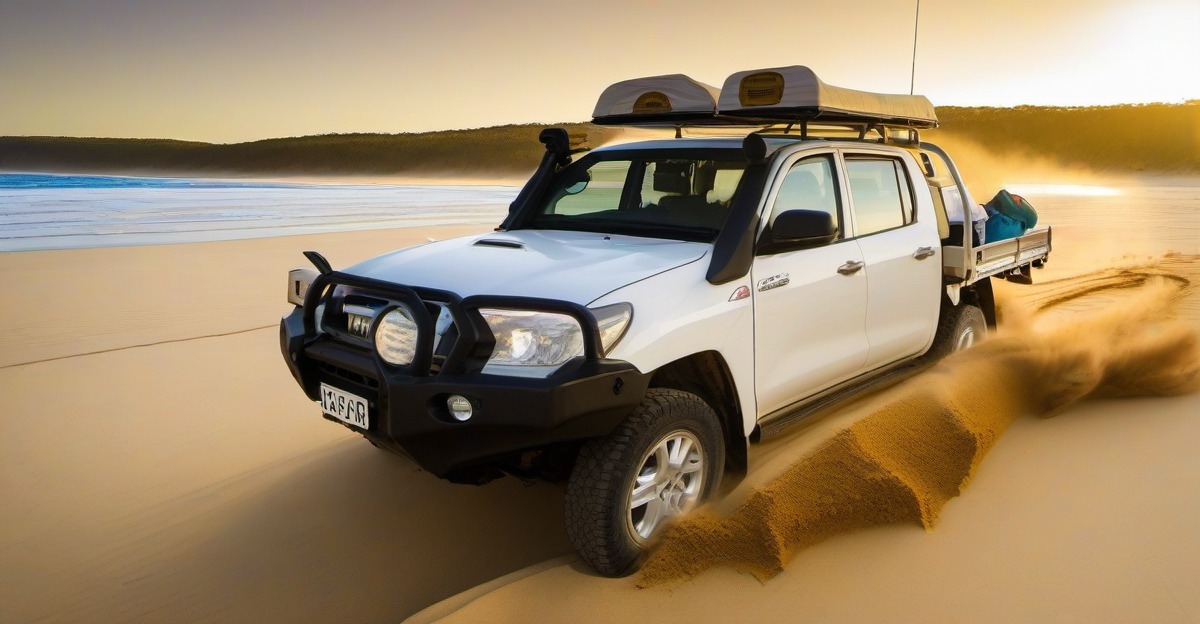
Eighteen psi at the Barge. Not 22.
If you remember nothing else from this page, remember that number If you want to try it, I recommend the Fraser Island Full Day 4Wd Tour.. Eighteen psi on all four tyres, before you drive off the barge at Inskip or River Heads, before your front wheels touch the sand. Not 22. Not 20. Eighteen. I run a recovery service on Fraser Island. I have pulled 47 tourist vehicles out of the sand in my time here. Every single one of them had one thing in common, and it is the thing you can fix in five minutes at the barge with a $20 tyre deflator from a camping shop.
from a camping shop.Highway pressure is around 35 to 40 psi on most 4WDs. On a sealed road that gives you fuel economy, steering response, and a comfortable ride. On soft sand, it does the opposite of all three. A tyre pumped to road pressure sits on top of the sand rather than flexing over it. The contact patch shrinks. The tyre digs. Within 500 metres of soft sand, sometimes less, you stop. Sometimes you stop dramatically, with the chassis sitting on the sand and all four wheels spinning useless air.
We earn a commission when you book through our links on Viator (PID P00299531), at no extra cost to you.
If you have never done Fraser before, the smart move is to sit on the passenger side the first time and let someone who knows the tide charts and the soft patches drive. The tour I put nervous first-timers on is the Fraser Island Full Day 4WD Tour, because someone who reads the sand is at the wheel while you actually look at the island. You still see the whole loop. You just do not end up as recovery number 48.Tyre Pressure: The Number and How to Get There
Eighteen psi is the working pressure for a half-loaded 4WD on Fraser Island sand. A heavily loaded vehicle with three adults, luggage, and camping gear can run a touch lower. A light vehicle with two people and day bags can run a touch higher. Anywhere between 16 and 20 psi works. Above 22 psi and you are gambling. Below 14 psi and you risk popping the tyre off the bead on a hard corner, especially in cold weather.
Bring a tyre deflator. The cheap plastic units from camping stores are fine for occasional use. The metal units with a gauge built in are worth the extra if you drive sand more than once a season. Pre-set your pressure on the bitumen at the barge carpark. Walk around the vehicle, deflate all four tyres evenly, and confirm with a separate tyre gauge. The barge crew will not do this for you. The hire car company almost certainly did not.
Re-inflate before you hit sealed road on the way off the island. Driving on the bitumen at 18 psi is not safe. The sidewalls flex, the steering goes vague, and the tyres heat up fast. Most barge crossings allow 10 to 15 minutes on each end for tyre pressure work. Use them.
Gear Selection: Low Range, Second Gear, Steady Throttle
Most modern 4WDs have a low range transfer case. Use it. Low range gives you torque multiplication and precise throttle control without spinning the engine. In low range, start in second gear, not first. Second gear keeps your rpm in the middle of the power band on soft sand. First gear is too short. The torque shock at take-off is exactly what digs a vehicle in.
Once moving, hold a steady throttle. Do not feather the accelerator. Do not try to modulate speed with the right foot. Pick a rev band that feels like the vehicle is walking briskly and keep it there. Let the gear pull you through soft patches rather than the throttle pushing you.
Automatic transmissions are fine on sand, but you must put the gearbox in manual mode and select second gear yourself. If you let the auto box decide, it will hunt between first and second when the going gets soft. Every downshift is a small shock to the drivetrain and a small moment where the wheels can break traction and dig.
Centre differential lock, if your vehicle has one, engage it before you hit the sand. A locked centre diff forces power to both front and rear axles. On sand, this is exactly what you want. If your vehicle has a traction control button, turn it off. Traction control on sand cuts power the moment a wheel slips, and on sand you want power flowing to the wheel that has grip, even if the other three are spinning.
Momentum: Your Friend Until It Is Not
Momentum is the single biggest idea in sand driving. You keep moving. You read the track ahead for washouts, soft patches, and ruts from other vehicles. You never stop on an uphill soft patch, because starting again from a dead stop in deep sand is how vehicles bury themselves to the axles.
This is where new drivers make the worst mistake. They drive into a soft patch, feel the vehicle slow, and lift off the accelerator to assess. The vehicle stops. They try to restart. They are now bogged. The fix for the soft patch was to keep the throttle steady through it, not to back off and think.
Momentum has a limit. On a steep uphill, momentum is not your friend. Brake gently before the climb, build revs in second gear low range, and let the engine torque walk you up. If you lose half-way up a steep soft hill, you do not push through. You stop. You reverse down under control, find a different line, and try again. Pushing throttle into a stalled uphill is recovery territory.
Tide Timing on Seventy Five Mile Beach
Seventy Five Mile Beach is a legal road, a registered highway, and the only way to drive the eastern side of Fraser Island. It is also a beach. The tide does not care about your schedule. The beach is drivable for around four to five hours around low tide. Outside that window, you are either driving through soft sand near the dunes or stopped because the water is over the road.
Plan your day around the tide, not the other way around. The tour operators and the experienced self-drivers all start early. A 7 at the departure from Inskip with low tide at 9 at the gets you the firm, damp sand in the middle of the beach for the run up to the Maheno shipwreck, Eli Creek, and the coloured sands at The Pinnacles. A 9 at the departure with low tide at 9 at the puts you on the soft shoulder for the first hour and costs you time.
The barge timetable is built around the tide for the same reason. The departure slots at Inskip and River Heads are not arbitrary. They line up with low tide on the eastern beach. If you miss your barge slot, you miss the tide.
When You Bog: Stop, Air Down, Clear, Then Use Recovery Tracks
You have stopped on soft sand. You cannot reverse. You cannot drive forward. Here is what to do, in order.
One. Stop spinning the wheels. Do not floor it when you are bogged. That just digs the chassis deeper. Every extra second of wheelspin buries the vehicle further and turns a soft patch into a recovery job rather than a self-extrication.
Two. Air down further. You are probably already at 18 psi. Go to 14. Go to 12 if your tyres and vehicle allow. Lower pressure lengthens the contact patch and lets the tyre mould over the sand rather than sitting on top of it. In many cases, simply airing down is enough to drive out.
Three. Clear the sand from behind the tyres. The sand has piled up against the back of the wheels as you dug in. Shovel it back, away from the vehicle, in all four corners. This frees the tyres to rotate and gives them something to push against when you back out. A small hand shovel from the camping kit is enough. Most hire 4WDs come with one. If yours does not, buy one before you drive off the barge.
Four. Reverse out under control. Reverse is usually easier than forward because you have a clear rut behind you. Use second gear low range, steady throttle. Do not spin. If you have cleared the sand and aired down, the vehicle should walk itself back out.
Five. Use recovery tracks. If reverse does not work, reach for the recovery boards. Most hire 4WDs in Hervey Bay come with a pair of plastic or composite recovery tracks. Place them in front of (or behind, if reversing) the driven wheels. The track gives the tyre something solid to push against. Drive out under steady throttle. Do not spin.
Recovery gear that you should have in the vehicle, and that the hire companies may not include: a snatch strap with rated shackles, a shovel, a deflator, a 12-volt air compressor for re-inflating on the mainland side, and a tyre pressure gauge. If your hire vehicle does not have these, leave the barge, turn around, and hire one that does.
Who Should Not Attempt Fraser Only
First-time 4WD drivers. That is the short list. If you have never driven on soft sand, do not hire and attempt Fraser only. I at the not gatekeeping. I at the telling you the pattern I see every season. Confident drivers used to bitumen assume sand is just a different surface. It is a different discipline, with tide windows, pressure management, recovery gear you may not own, and no phone signal across large parts of the island. If something goes wrong out there, help is hours away, and the tide does not pause for you.
If you have done real off-road sand work before, brought your own recovery boards, and you understand tide charts, then yes, a self-drive permit trip can be one of the best drives in Australia. If any part of that sentence made you pause, book a guided tour for the first visit and learn the island by watching someone who does it every week. You can always come back and self-drive once you have seen how it behaves.
Book a Guided Sand Run
Common Questions
What tyre pressure for Fraser Island sand?
Eighteen psi is the standard working pressure. Heavily loaded vehicles can run 16. Light vehicles can run 20. Anything above 22 and you are gambling with bogging. Air back up to road pressure before you hit sealed road.
Can you drive a 2WD on Fraser Island?
No. The inland tracks are soft sand and require a high-clearance 4WD. A regular car will be stopped within the first kilometre. This is one of the spots where the hire-car insurance explicitly excludes you.
What gear to use on sand?
Low range, second gear, steady throttle. Lock the centre diff if you have one. Turn off traction control. Do not use first gear to start, the torque shock digs the vehicle in.
What happens if you bog on Fraser?
Stop spinning. Air down further to 14 psi. Shovel the sand back from behind all four wheels. Reverse out under control. If reverse fails, use recovery boards in front of the driven wheels and drive out under steady throttle. Do not floor it, it digs the chassis deeper.
Is it safe to drive on Seventy Five Mile Beach?
Yes, around low tide. The beach is a registered highway and a normal driving surface at the right tide, but it is closed to traffic outside the safe tide window. Check the tide chart before you plan your day.
Explore More
Related guides and comparisons: