Why Hervey Bay, and Why July to November
Every winter, around 30,000 humpback whales migrate north along the Queensland coast. They are heading to the warm tropical waters of the Coral Sea to calve. On the way back, between July and November, they pause in Hervey Bay. They use the sheltered, shallow waters west of K'gari as a resting point, a playground, and a nursery for newborn calves. It is one of the most reliable whale watching locations in the world, which is why Hervey Bay calls itself the whale watching capital of Australia and the title is not marketing spin.
It is not marketing spin because the whales come to Hervey Bay on their own schedule, not on the operator's. The mothers with newborn calves stay in the bay for an average of 11 days before continuing the migration south to Antarctica. The younger males and non-pregnant females often stay longer. The competitive pods, which are groups of males chasing a single female, can show up at any time during the season and put on the most spectacular display you will see on the water.
Peak season is mid-August through late September. By October the southbound migration is well underway, and most mothers with calves have already left the bay. The first week of August and the last two weeks of October are quieter. Bookings in those shoulder weeks are easier to get, the water is often calmer, and the operators are more willing to stay out longer with a single pod.
What You Will Actually See on the Water
You will see a lot more than a single grey back. A typical three-hour Hervey Bay whale watching cruise produces three to six different encounters with different pods, and the behaviour changes through the season. Here is what to expect.
The first thing you will see is a blow, the cloud of misty air a humpback pushes out when it surfaces. It is visible for kilometres on a calm day and is how the captain locates the pod. Once the boat is in range, the whales will surface, breathe, and dive in a pattern called a sounding sequence. Three to five breaths, then a long dive, then another sequence five to ten minutes later. This is when you have your camera out.
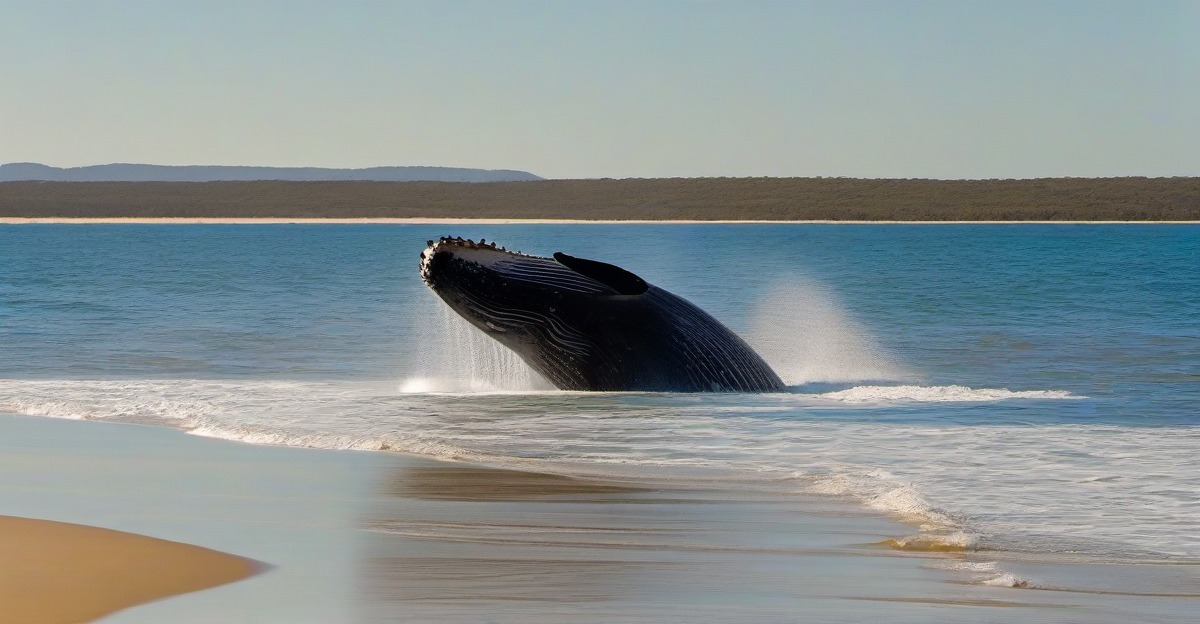
Then the show starts. Humpbacks in Hervey Bay are famous for breaches, the full body launch out of the water. An adult humpback weighs around 40 tonnes. When 40 tonnes of whale leaves the water and lands on its side, you hear it, you feel it in the boat, and you can see the splash from kilometres away. The record for a single breach sequence in Hervey Bay, as told to me by a captain I work with, is over 40 breaches from one animal in 40 minutes. It was a juvenile male, putting on a show for a female nearby.
The Five Behaviours Worth Knowing
Mothers with newborn calves are the most common encounter from August onwards. The calf stays within a body length of the mother, surfacing every two to three minutes to breathe. The mother rests, log-still at the surface, while the calf practises breathing, rolling, and small breaches. Stay at least 100 metres from mothers and calves under the federal whale watching guidelines. The operators enforce this. Do not ask the captain to get closer.
The classic displays to watch for are breaches and tail slaps. Tail slaps are when a humpback lifts its fluke out of the water and slams it down, sometimes repeatedly, for ten minutes or more. The meaning is not well understood. It may be a feeding signal, a social signal, or simply a way to scratch an itch. Either way, it is a stunning visual. Tail slaps are most common on calm days.
Competitive pods are the showstopper. A group of males chases a single female at high speed, often with ten or more animals involved, breaching and tail-slapping as they go. The female tries to evade them. The males compete with each other through physical contact, ramming, and bubble blasts. You will see this in Hervey Bay from late August through September, mostly in the morning, and it is the reason a lot of repeat whale watchers keep coming back.
Spy hopping is when a humpback lifts its head vertically out of the water, rotating to look around. Humpbacks have eyes the size of dinner plates and a genuine curiosity about boats. A spy hop close to the vessel is one of the most common forms of whale-to-human interaction you will see.
Peduncle throws, where the whale throws the back half of its body out of the water using the strong muscular peduncle at the base of the tail, are less common but dramatic. A peduncle throw is a humpback equivalent of a tantrum, usually associated with competitive pods or with a mother defending a calf. You will know it when you see it, and the boat will rock.
Morning vs Afternoon: The Honest Tradeoff
Morning departures have better light. Afternoon departures have calmer water. Choose morning for photos, afternoon for comfort.
That is the honest answer. The first morning cruises leave Hervey Bay marina around 7:30 at the, with the sun coming up behind the boat and the light catching the blows at a low angle. The water is usually a bit choppier in the morning, especially if the overnight wind has been southerly. By late morning the wind often drops and the water flattens out, but the sun has also climbed and the light is harsher.
Afternoon cruises, typically 1 pm to 4 pm in peak season, run on calmer water. The afternoon light is warmer. The downside is that you are looking back toward the sun, and the photos of breaching whales come out as silhouettes against a bright sky. If you care about photography, go morning. If you care about comfort, go afternoon. The whales do not have a preference either way.
One practical tip. The 1 pm departure in peak season is the most popular cruise, the boats are usually at full capacity, and the whales have been watched by the morning boats before you arrive. The 7:30 at the departure gets you to the whales first. If the morning boat has had a spectacular encounter and stayed with a pod, the afternoon operators often know where to find that same pod when they leave the marina.
The Whale Sighting Guarantee
Most Hervey Bay operators offer a free return cruise if no whales are sighted on your trip. This is not a marketing line. It is industry practice in Hervey Bay because the sighting rate is so high that the operators can afford to underwrite the rare bad day.
The industry sighting rate across the fleet runs around 98 to 99 percent during peak season. A bad day in Hervey Bay, defined as a full cruise with no whales sighted, is unusual enough that the operators write it into their terms to keep bookings flowing. If you do strike a bad day, you get a free return cruise, usually valid for the rest of the same season.
Read the small print before you book. The standard terms are that the entire cruise, every passenger on board, must not sight a whale. If the captain sights a pod at the edge of visibility and the passengers only see a blow or a back, that still counts as a sighting under most operators' policies. The free return is for genuine blank days, which is rare. If you are booking in July or the first week of August, when the whales are just starting to arrive, the guarantee is worth checking. By mid-August you can book with confidence.
Note that the guarantee does not always cover bad weather cancellations. If the operator cancels the cruise due to rough conditions, you get a refund or reschedule, not a free return. If the operator goes out and the weather is rough but the whales are still around, the cruise runs and the guarantee does not apply.
What to Bring on a Whale Watching Cruise
Camera with a zoom lens, warm jacket, binoculars. That is the short list. The long list is below, and the warm jacket is the one people underestimate the most.
Even in the middle of the Queensland winter, the wind chill on a Hervey Bay whale watching cruise can be substantial. The bay is sheltered, but the boats travel at 20 to 25 knots to reach the whales, and a steady 15 knot wind on top of an ambient 18 degrees Celsius drops the effective temperature on deck to single digits. People who thought they would be fine in a t-shirt are huddled below deck by the second pod. Bring a windproof jacket, ideally one with a hood, even if the forecast on land looks warm.
A camera with a zoom lens is the second item you will thank yourself for packing. A 200mm lens is the minimum. A 400mm or longer zoom is better. The boats are required to stay 100 metres from the whales, and the whales can be on the far side of the pod. Cropping a phone photo is fine for social media, but for a real breach shot you need optical zoom. If you do not have a long lens, the captain will usually rotate the boat so passengers on each side get a turn close to the pod. Ask when you board.
Binoculars are useful but not essential. The captain's job is to find the whales and put you in the right position. Binoculars help when the pod is on the far horizon or when you want to watch a specific animal's behaviour. A compact pair, 8x42 or 10x42, is fine.
Other items that matter: sunscreen, even on cloudy days, because the wind masks the UV exposure and you will burn faster than you think. A refillable water bottle. A hat with a strap, because the wind will take a loose hat over the side. Motion sickness medication if you are at all prone, taken 30 minutes before departure. The bay is usually calm but not always, and the head of the boat moves the most.
Which Operator to Book
There are around half a dozen commercial whale watching operators running out of Hervey Bay. They all leave from the same marina, all run roughly the same three-hour format, and all offer the sighting guarantee. The differences come down to vessel size, catering, and the captain's reading of the day's conditions.
Smaller vessels, holding 20 to 40 passengers, get you closer to the whales because they are less restricted by the federal guidelines that scale with boat length. The trade-off is that smaller boats move more in the swell, and the spray can be heavy on a choppy day. Larger vessels, holding 100 or more passengers, are more stable, have indoor and outdoor viewing decks, and usually include a meal or a hot drink service. They cannot get as close to the whales, but the photo opportunities from the upper deck can be excellent.
All Hervey Bay operators are licensed under the Queensland Department of Environment and Science, and all comply with the federal whale watching guidelines. The guidelines are enforced. A captain who pushes too close to a pod risks losing the licence. The whales are protected animals, and the operators are the first line of that protection. If you have a complaint about a captain getting too close, report it to the Department. The operators are usually better than that, but the option is there.
Bookings in peak season, August and September, should be made at least two weeks in advance for morning cruises and at least a week in advance for afternoon cruises. Walk-up bookings are possible in shoulder season but you may end up on a less convenient departure time.
Combining a Whale Watching Cruise with a Fraser Island 4WD Tour
Most visitors to Hervey Bay who are reading this site are also going to do a Fraser Island 4WD tour. The two activities combine well. The standard three-day Hervey Bay itinerary is a whale watching cruise on day one, a 4WD tour on day two, and a buffer day on day three in case weather cancels one of the previous days.
Accommodation in Hervey Bay clusters around the marina and the Urangan pier, and most operators offer free hotel pickup and drop-off for both activities. You can do a 4WD tour from 7:30 at the to 5:30 pm, a whale watching cruise the next morning from 7:30 at the to 10:30 at the, and still have the afternoon free.
The shoulder week trick. If you are flexible, the first week of October is often the best compromise. The whales are still around, the crowds have thinned, the water is calm, and you can usually book both tours a day or two in advance. The 4WD tour inland tracks are at their driest, which makes for better driving conditions and better photography at Lake McKenzie.
Book a Hervey Bay Whale Watching Tour
Explore More
Related guides and comparisons: