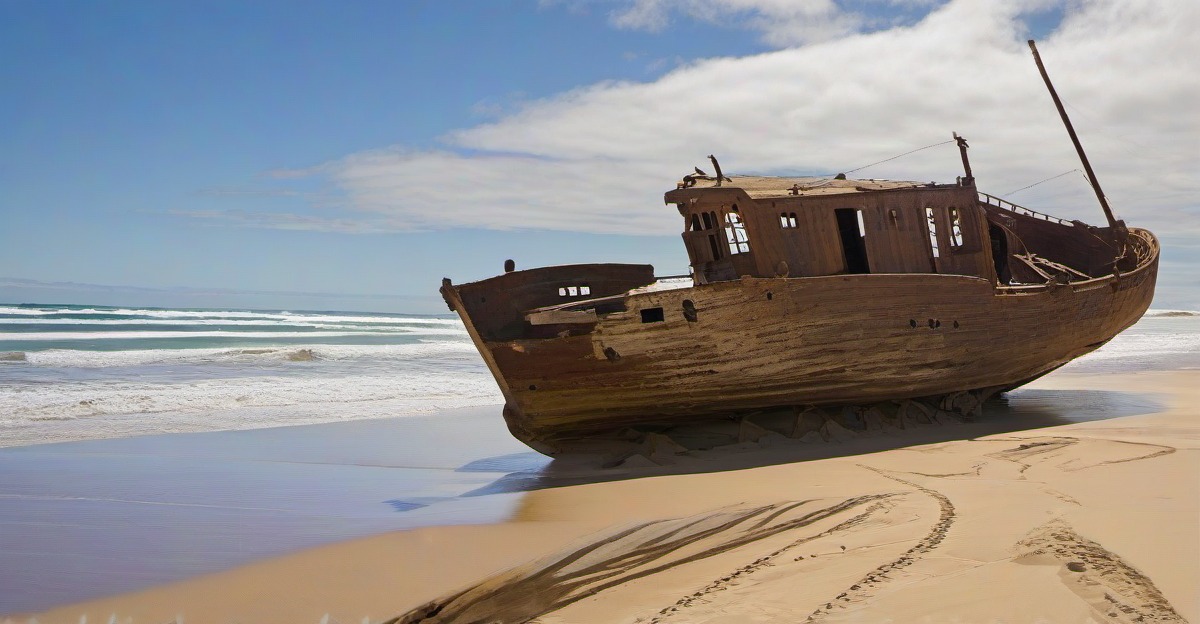
A Brief History of How a Scottish-Built Ocean Liner Ended Up in the Sand
The SS Maheno was built in 1905 in Dumbarton, Scotland, by William Denny and Brothers. She was 400 feet long, weighed just over 5,000 tons, and was one of the first turbine-driven steamers built for the trans-Tasman route. For twenty years she ran between Sydney and Auckland as one of the most comfortable passenger ships on the route. She carried thousands of migrants, honeymooners, and businessmen across the Tasman, and was considered a prestige posting for crew.
By 1935 the Maheno was past her prime and had been sold to a Japanese ship-breaker in Osaka. She was being towed across the Pacific under tow by the tugboat Marana when a cyclone came through off the east coast of Australia. The tow line parted somewhere northeast of Fraser Island. The Maheno drifted, took on water, and drove herself ashore on 75 Mile Beach on the 5th of July 1935. The crew was rescued. The ship stayed.
She has been there ever since. The cyclone that wrecked the Maheno is the same cyclone that has been slowly dismantling her for ninety years. Rust, salt, tide, and wind have reduced her to a skeleton on the sand. She used to be a complete hull with masts. By the time I first saw her in 2014, the upper decks were gone. By 2020 the funnel had collapsed. By last year, the bow section had visibly tilted toward the surf.
Where the Maheno Sits on 75 Mile Beach
The Maheno is roughly fifteen kilometres north of the Eurong township, on the eastern beach of K'gari. She sits about 80 metres inland from the high-tide line, which sounds safe until you understand that the sand shifts every year and the high-tide line has moved more than once. There was a winter in 2017 when the waves came within 30 metres of the wreck. The day tour buses stop on the beach nearby. The photographers walk the same well-worn path from the car park to the rust.
She is on 75 Mile Beach, which is also a designated highway. Aircraft land on it. Vehicles drive on it. There is no formal parking area, but the sand near the wreck is usually firm enough that a competent driver can pull off the through route without bogging. That is not a challenge. Most days there are already a dozen vehicles parked when you arrive.
Best Light: Sunrise and Sunset, Nothing in Between
The Maheno photographs best when the sun is low. This is not an artistic opinion. It is the physics of oxidised steel and raking light. The hull is rust, and rust is textured. When the sun is overhead, the texture flattens to a brown smudge against a brown sky. When the sun is at five degrees above the horizon, the texture throws shadows, the colour goes red and orange, and the wreck looks like a real ship instead of a featureless silhouette.
Sunrise is the photographer's choice for two reasons. First, the eastern sun catches the wreck on the camera-facing side, which is the side of the hull with the most visible decay. Second, the beach is empty before 7 at the. There are no tour buses, no drones, no selfie-sticks, and no children. You can stand on the sand and take your time. The only sound is the surf and the wind.
Sunset works too, but the light comes from behind the wreck and you are shooting into the sun. The classic Maheno silhouette is a sunset shot. The classic Maheno detail shot, the one with the rust texture and the rivets and the broken hull plates, is a sunrise shot. Get there for both if you can.
Midday is the time to skip. The light is harsh. The wreck looks flat. The tour buses have arrived and the composition is full of strangers. You will get a photograph that proves you were there, but you will not get a photograph you want to print.
You Cannot Go Inside the Wreck
I at the going to say this plainly because people keep asking. You cannot go inside the SS Maheno. It is not a tourist attraction. It is a structural collapse in slow motion. The Queensland Parks and Wildlife Service has fenced off the wreck and put up signage. The signs are not decorative.
The wreck is rusting into the sand, and a section collapses roughly every two years. I have watched the bow section tilt a further ten degrees since I first started guiding here. The funnels are gone. Decks are gone. The steel is paper-thin in places. A section that holds your weight today might not hold it next month. And once you are inside a collapsed section, you are in a position that requires a helicopter to extract you from.
This has happened. More than once. In 2020 a tourist climbed through a window into the lower hull and a section gave way under his foot. He was stuck for forty minutes before a rescue helicopter pulled him out. He spent the rest of his Australian holiday in hospital. In 2022 a woman posted on social media inside the wreck and the post went viral because she was standing on a piece of the ship that collapsed the following week. She was lucky she was not on it when it went.
Stand back. Take your photo. Do not be the tourist who required helicopter extraction from inside a 90-year-old shipwreck. The wreck will be there for another ten or twenty years, slowly disappearing into the sand. The photo you take from twenty metres away is the same photo you would take from inside, except the one from outside is not stupid.
What You Will Actually See on the Sand
The Maheno is not a complete ship. It has not been a complete ship for decades. What you see today is the lower hull, the keel, the boiler room structure, and the bow. The superstructure, the masts, the funnel, the deck fittings are all gone. The wreck looks like a giant ribcage half-buried in the sand, with the bow facing roughly north and the stern section broken off and buried further down the beach.
The colour is what gets people. The hull is bright orange and red where the rust is fresh, dark brown where it has oxidised for decades, and pale grey where the original steel is still visible. It is one of the most photogenic things on the east coast of Australia, and the photographs you see online do not lie about how it looks.
You can walk all the way around the wreck. You can get within five metres of the hull. You can photograph the bow, the stern, the broken keel plates, the rivets, the boilers, and the rust patterns. You do not need to climb on the wreck to get the photograph. The composition works from the ground.
What to Wear and Bring
Wear closed-toe shoes. The sand at the Maheno is littered with small pieces of rusted metal that have broken off the hull over the years. They are sharp. They cut through thongs and sandals without any effort. I have pulled rusted plate fragments out of people's feet at the first-aid station at Eurong more times than I can count. Closed shoes. Every time.
Bring water. The eastern beach has no shade, and the walk from the car park to the wreck is 200 metres of exposed sand. Even in winter, the sun will cook you if you stay for an hour.
Bring a camera with manual exposure. The bright sky behind the wreck will fool your phone's automatic settings. Tap to expose for the rust, not the sky, and your photos will improve immediately.
How to See It on a Day Tour
We earn a commission when you book through our links on Viator (PID P00299531), at no extra cost to you.
The Maheno is on the itinerary of every full-day 4WD tour of Fraser Island, because the eastern beach highway runs right past it. The Full Day 4WD Tour of Fraser Island stops at the wreck for twenty to thirty minutes, which is enough time to walk around it, take the photographs, and listen to the guide explain how a 5,000-ton ocean liner ended up in the middle of a sand island. The tour product code is d366-5199FRASER if you are searching directly on Viator.If you want the wreck at sunrise, you will need to camp on the island or stay at the Eurong resort, because the day tours do not run early enough to catch the dawn light. The self-drive sunrise is the best photograph. The guided midday is the most convenient. Pick the one that fits your trip.
Explore More
Related guides and comparisons: