Fraser Island Costs — A Complete Guide
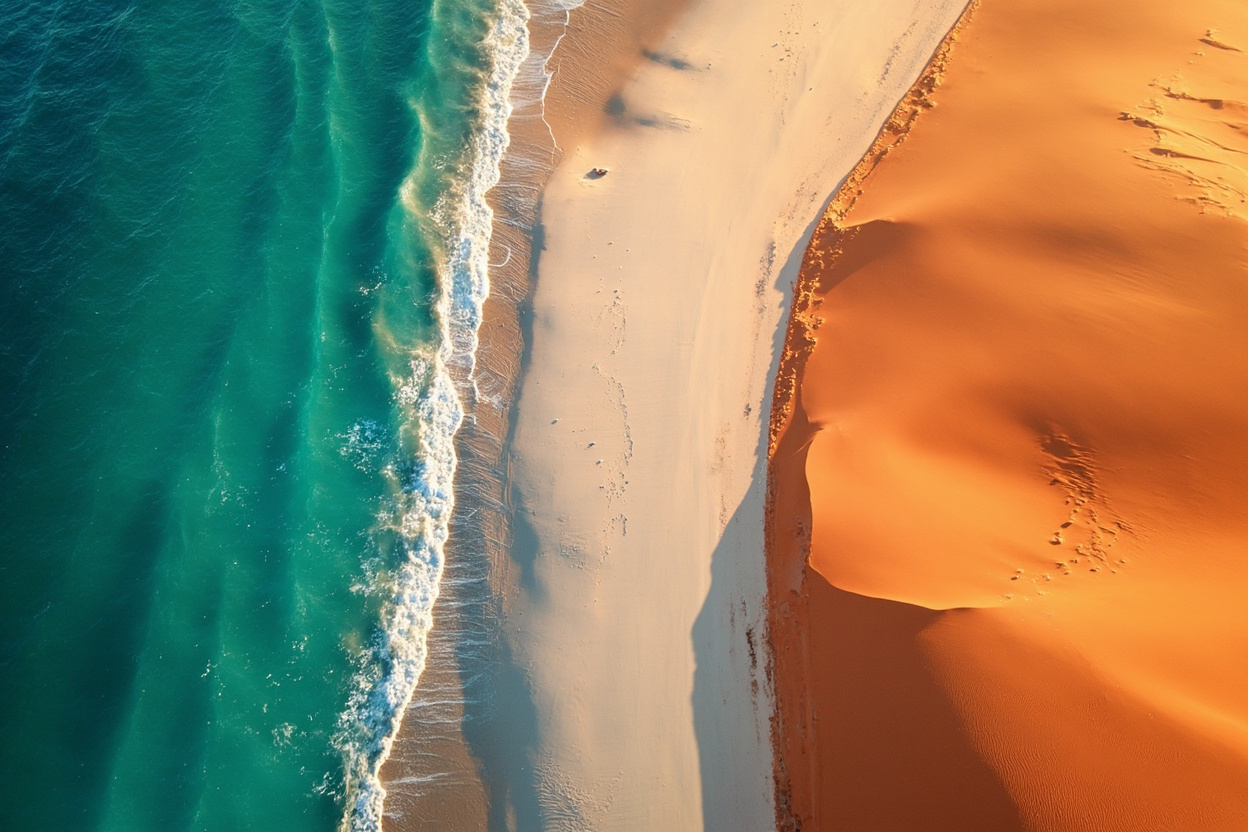
I Didn't Expect Fraser Island (K'gari) to Feel Like This
The first time I drove off the barge at Inskip Point, I thought I'd made a terrible mistake. It was January 2020, 34 degrees, and the humidity hit me like a wet blanket. My mate's 4WD — a beat-up Pajero we'd borrowed from his uncle — was loaded with camping gear, two eskies, and way too much confidence. Within 200 metres of hitting the sand, I realised I had no idea what I was doing with tyre pressures. We crawled along at 15km/h, fishtailing on every corner, praying we didn't meet another vehicle on the single-track inland road.
That trip cost me about $1,200 all up — permits, fuel, food, and the barge. But I made every rookie mistake in the book. I didn't book campgrounds ahead, so we ended up at a packed site near Eurong where the dingoes patrolled like they owned the joint. I ignored the tide chart and nearly lost the Pajero to the incoming tide on 75 Mile Beach. And I definitely didn't budget for the $600 recovery fee when a mate got bogged at Ngkala Rocks because he thought his all-wheel-drive SUV would handle the soft sand. It didn't.
Fraser Island — or K'gari, as the Butchulla people have called it for tens of thousands of years — is the world's largest sand island, stretching 123km along Queensland's coast. It's raw, wild, and truly beautiful. But it's also expensive if you don't know what you're doing. The fraser island costs add up fast: vehicle access permits ($55.90 for up to one month in 2026), barge fees, fuel at $2.40-$2.80 per litre at Eurong or Happy Valley, and campground bookings that vanish months ahead for school holidays. And that's before you factor in the stuff that breaks — because something always breaks.
I've been back a dozen times since that first disaster. I've camped at every official campground, driven every inland track at least twice, and sat through enough ranger briefings to recite the dingo safety rules in my sleep. Here's what I've learned about making the numbers work without losing your mind — or your wallet.
Dingos 3-Day Tag-Along Fraser Island 4WD Adventure — The Tour That Saved My Trip
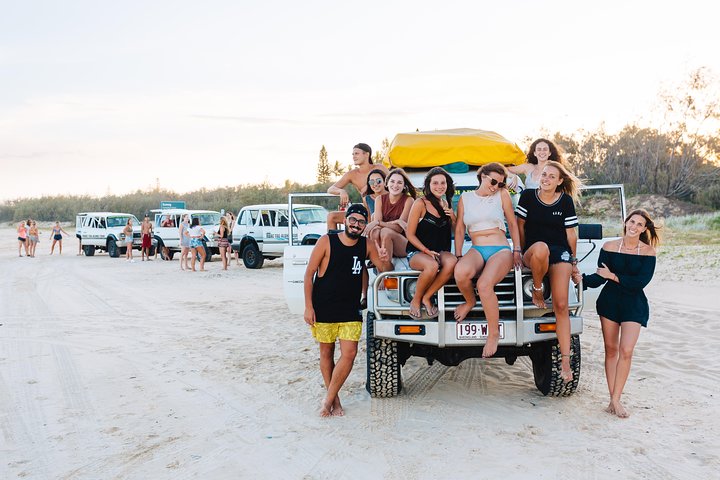
After that first expensive solo trip, I decided to try a different approach. I booked the Dingos 3-Day Tag-Along Fraser Island 4WD Adventure — a guided tag-along tour where you drive your own vehicle in a convoy with a guide leading the way. Best decision I ever made for understanding the island's costs and logistics.
The tour runs with a group of 20-30 people, and you camp at designated sites like Central Station or Waddy Point. The guide quality varies enormously — my first guide was a marine biologist who could name every dune formation and tidal pattern. My second guide read from a script and skipped the Champagne Pools entirely. If you get a good one — usually the older, long-term guides — it's an incredible education in the island's ecology. The tour costs around $400-500 per person for three days, which includes vehicle permit, campground fees, and some meals. Compared to my first solo trip where I spent $1,200 and still got bogged, it's actually decent value.
Who it's NOT for: Anyone who wants privacy or hates group camping. You'll be sharing a camp kitchen with strangers, and the sandflies at Central Station don't discriminate.
Dingos 3-Day Tag-Along Fraser Island 4WD Adventure
Best-value way to see Fraser Island if you don't have your own 4WD. Three days of camping, driving, and swimming with a group of 20-30 people. Guide quality varies — get a good one and it's an incredible education in island ecology. Budget-conscious backpackers and solo travellers love it.
 Check Availability →
The Moments That Made island adventure tours in Fraser Island (K'gari) remarkable
Let me tell you about Eli Creek at 6:15am on a September morning in 2020. I waded in when the water was still glass and the only footprints on the boardwalk were mine. The creek was so clear I could count individual grains of sand on the bottom. By 9am there were 40 people floating down on inflatable tubes and the magic was gone. That's the thing about island adventure tours in Fraser Island (K'gari) — the timing is everything. The boardwalk opens at dawn. Use it.
Then there was the whale encounter in Hervey Bay, August 2021. I booked the cheapest whale watch I could find — $89 for a 4-hour cruise. The boat had 120 people on it and by the time a humpback surfaced 200 metres off the port side, I was wedged behind a family of five with iPads. I saw the whale through their screens. Pay the extra $40 for the smaller boat with a capped passenger count. Whale watching is one of those things where the cheapest option actively ruins the experience.
Fast forward to September 2024: I paid $130 for a 24-passenger boat departing at 7:30am from Urangan Marina. By 8:15 we'd found a mother and calf in Platypus Bay. The skipper killed the engines and we drifted. For 45 minutes the calf circled us at less than 30 metres, breaching seven times, landing sideways each time like it was showing off. The mother cruised underneath, a shadow the size of a bus. Nobody spoke. Nobody filmed. Everyone just watched. The early-morning boats see more active whales, and the small boats get closer without breaking the law. The $130 ticket is the difference between "I saw a whale" and "I'll remember that for the rest of my life."
If you're short on time, the Fraser Island Day Tour from Hervey Bay is the path of least resistance. A comfortable 4WD bus takes you to Lake McKenzie, Central Station, Eli Creek, and the Maheno in one packed day. It's rushed — you get about 45 minutes at each stop — but you see the highlights without driving yourself. It's a solid option if you're nervous about sand driving or just want a taste without the commitment.
Fraser Island Day Tour from Hervey Bay — A lesser-known spot Worth Discovering
For time-poor visitors or families with young kids, this day tour is a lifesaver. You don't have to worry about tyre pressures, tide charts, or dingo-proofing your esky. The bus handles everything, and the guides know the island well enough to avoid the worst of the crowds. I've taken this tour twice — once with mates who didn't want to drive, and once with my sister and her kids. Both times, we saw everything we wanted without the stress. The downside? You're on a schedule. You can't linger at Lake McKenzie when the light is perfect because the bus leaves at 11am sharp.
Who it's NOT for: Photographers who want golden-hour light, or anyone who hates being herded. You'll spend more time at the Maheno shipwreck than you probably want.
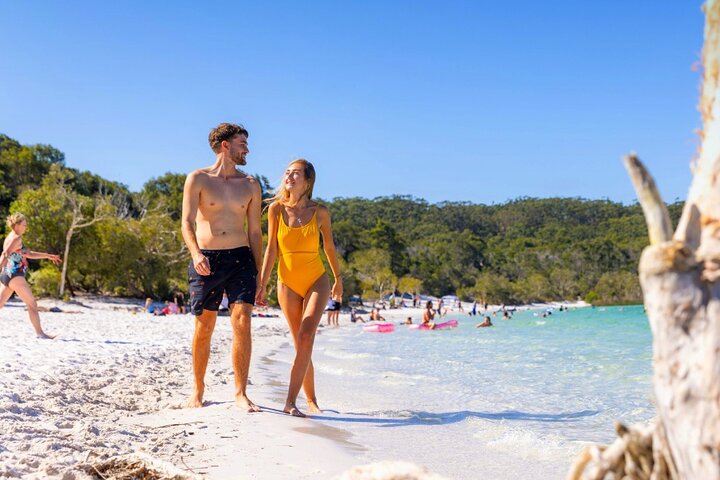
Fraser Island Day Tour from Hervey Bay
The path of least resistance. A comfortable 4WD bus takes you to Lake McKenzie, Central Station, Eli Creek, and the Maheno in one packed day. Rushed but efficient — you get about 45 minutes at each stop. Best for: Time-poor visitors, families with young kids, anyone nervous about sand driving.
 Check Availability →
What Really Surprised Me About Fraser Island (K'gari)
I've spent enough time on K'gari to know that the island doesn't care about your plans. Here are the things that caught me off guard, trip after trip.
The sandflies at Central Station are relentless. January 2023, I pitched my tent at 4pm in 34-degree heat with 90% humidity. By 5:30pm my ankles were covered in sandfly bites — raised, itchy welts that lasted ten days. I had DEET in the car but thought "I'll just be a minute." Sandflies don't need a minute. Apply repellent before you leave the car. December-February is peak season for them, and the bites itch for over a week. Bring mozzie coils AND DEET spray — the $12 Bunnings mozzie net was the single best decision of that trip.
Inland tracks after rain are a nightmare. February 2023, 80mm of rain fell overnight — not forecast, just one of those summer dumps that comes out of nowhere. The track from Central Station to Lake McKenzie was a series of mud holes the size of bathtubs, each one deep enough to swallow a wheel. We crawled along at 3km/h, winching twice, arriving at Lake McKenzie just as the afternoon storm rolled in. Two cars behind us gave up and turned back. Check the rain radar before you commit to inland tracks after wet weather. QPWS doesn't close roads preemptively — they wait until someone gets stuck. And bring a snatch strap and rated recovery points, not just a tow ball.
Dingoes are faster than you think. April 2023 at Waddy Point Campground, I turned my back on the camp table for maybe 30 seconds to grab the billy from the fire. Heard the slightest rustle — turned around and a dingo was 50 metres into the scrub with my bacon and eggs in its mouth. Didn't run, didn't panic. Just walked off like it owned the place. Which, on K'gari, it kind of does. On Fraser Island, "supervised" means eyes on your food every single second. Not "I'll be right back," not "it's just on the table." If a ranger had seen it happen, the fine for improperly stored food is $312. The dingo got a free breakfast and I got a lesson I won't forget.
Fuel consumption doubles on sand. Soft sand driving uses about twice as much fuel as highway driving. My Pajero usually gets 10L/100km on the highway. On Fraser Island, I was getting 18-20L/100km. Fill up at the IGA in Rainbow Beach or the servo in Hervey Bay before you hit the barge — fuel at Eurong and Happy Valley is $2.40-2.80 per litre, and you'll burn through a tank in two days of inland driving.
The Champagne Pools are overrated at low tide. I've been three times. Once at low tide — looked at a damp rock and walked away. Once at mid-tide — decent, but crowded. Once at high tide with a decent swell — actually worth the drive. Check the BOM swell forecast before you go. If the swell is under 0.5m, skip them entirely.
Michael Chen's Insider Tips for Getting It Right
After a dozen trips, here's what I've learned that the guidebooks don't tell you.
- Book campgrounds 6 months ahead for school holidays. Central Station sells out within days of becoming available. I learned this the hard way when I rocked up in April with no booking and ended up at a private campground near Eurong that cost double and had no atmosphere.
- The barge from Inskip Point is cheaper and runs more frequently than River Heads for 4WDs. It's $55 for a vehicle plus $5 per passenger (2026 prices). The River Heads barge costs more and has fewer daily departures.
- Drop tyre pressure to 18psi BEFORE you hit the sand, not when you're already bogged. I've seen too many people deflating on the beach while their wheels spin. Do it at the barge landing or the air station in Rainbow Beach.
- Take the inland track to Lake McKenzie via Cornwells Break Road instead of the main Central Station track. It's rougher but faster, and you'll pass maybe 2 cars instead of 20. The main track is a traffic jam in peak season.
- The Eurong Resort pool is open to non-guests for $5. Best money you'll spend on a 35°C January arvo when the beach is undriveable at high tide. Cold beer, air conditioning, and a pool — it's a lifesaver.
- If you're swimming at Lake McKenzie, walk 200m along the shore from the main entry point. You'll have the place to yourself while everyone else crowds the main beach. The sand is just as white, the water just as clear.
- Download offline maps on your phone before you go. Google Maps doesn't have inland tracks. I use Maps.me with the Fraser Island overlay — it's saved me from getting lost in the scrub more than once.
- Whale-watching boats from Urangan Marina that depart at 7:30 AM see more breaches. Whales are more active in the morning before the wind picks up and the bay gets choppy. Book the early departure, even if it means getting up at 6am.
For a smaller-group day tour that feels more like a private experience, check out the Sunrover Exclusive Fraser Island Day Tour. Max 8-10 people, so you spend less time waiting for stragglers and more time actually enjoying the island.
What I Wish I'd Known Before I Went
If I could go back and tell my 2019 self what to expect, here's the list I'd tape to the dashboard.
- Vehicle recovery on Fraser Island costs $400-800 for a tow truck. RACQ roadside assist doesn't cover off-road recovery, and you'll wait 3-6 hours for a local operator. I've seen people stranded overnight because they didn't have a snatch strap. Bring one. And rated recovery points — not just a tow ball. A tow ball can snap off and kill someone.
- Don't drive at high tide on 75 Mile Beach. You'll lose your vehicle to the ocean or get fined. The rule is: no driving 2 hours either side of high tide. Check the tide chart before you leave. The rangers patrol and they're not lenient.
- Carry enough drinking water for your entire stay. There's no tap water at most campsites. I bring 10 litres per person per day for drinking, cooking, and washing. The Eurong bakery does decent pies and sausage rolls, but they won't fill your water bottles.
- Dingo safety fines are $2,400+. And dingoes will steal your food in seconds. Store everything in the vehicle or a dingo-proof box. Don't leave a single chip on the table. The dingoes at Waddy Point are particularly bold — they've learned that campers are an easy meal.
- Arrive with your permits sorted. Rangers check campgrounds and vehicle access regularly. You can buy permits online through QPWS before you go. The fine for not having one is steep — I've heard of people getting hit with $400+ on the spot.
- Don't try to climb the Maheno shipwreck. It's unstable, rusty, and officially prohibited. Every year someone ignores the signs and gets hurt. Stand back, use a zoom lens, don't be that person.
- If you're self-driving, the inland track from the barge landing to Eurong at high tide is a trap. It's 12km of soft sand and washouts that takes 45+ minutes instead of 15 on the beach, and you'll burn half a tank of fuel doing it. Wait for the tide to go out and take the beach.
- Book whale-watching during the first two weeks of September. It's the absolute peak of the southern migration and boats sell out 3-4 weeks in advance. You'll be stuck on a 120-person cattle boat with no viewing room if you leave it too late. I learned this the hard way in 2021.
The biggest lesson I've learned across all these trips is that fraser island costs are manageable if you plan ahead and avoid the common mistakes. The island will test your patience, your wallet, and your ability to stay calm when a dingo walks off with your breakfast. But it's worth it. Every time I drive off the barge, I remember why I keep coming back. The sand, the water, the silence at dawn on Eli Creek — that's what makes the costs worth it.
Explore More
Related comparisons and guides: