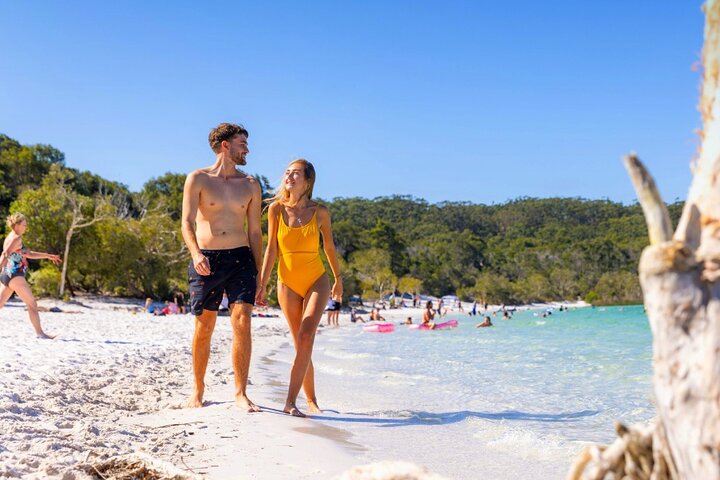
Fraser Island on a Budget — What It Actually Costs in 2026 | K'gari Travel Guide
Honest 2026 budget guide for Fraser Island (K'gari). Real costs, camping tips, 4WD advice, and what you can skip to save money. Written by a Queensland local who's done it all.
What's Your Fraser Island Budget?
✓ Self-drive makes sense if…
- You already own or can borrow a capable 4WD
- You're travelling in a group of 3+ to split costs
- You're comfortable with sand driving and tide planning
✗ Book a tour instead if…
- You don't have 4WD experience — bogging a rental costs more than a tour
- You're travelling solo — tours are almost always cheaper for one person
- You want a guide who knows the tides, the tracks, and the quiet spots
Explore More
Related guides and comparisons:
I Didn't Expect Fraser Island (K'gari) to Feel Like This
The first time I drove off the barge at Wanggoolba Creek, I thought I'd made a terrible mistake. It was January, the humidity was thick enough to swim through, and my mate's 1998 Pajero was already running hot. We'd spent $340 on permits and camping fees before we'd even seen a dingo. But then we hit the inland track to Central Station, and the canopy closed in — giant satinay and kauri pines, ferns taller than the car, and a silence that felt ancient. That's when K'gari stopped being a checklist and started being a place.
I've been back eleven times since that first trip. I've camped in every official campground, driven every inland track at least twice, and sat through enough ranger briefings to recite the dingo safety rules in my sleep. I've also made every mistake you can make — bogged at Ngkala Rocks, run out of water at Lake Wabby, and paid $280 for a single tank of fuel at Eurong because I was too lazy to fill up in Rainbow Beach.
This guide is the one I wish I'd read before that first trip. I'm going to tell you exactly what Fraser Island actually costs in 2026 — not the brochure numbers, but the real ones. The permit fees, the fuel bills, the campsite bookings, and the things you can skip entirely without losing the experience.
Fraser Island Tag-Along 4WD Tour — The Tour That Saved My Trip
On my second trip, I brought a mate who'd never driven on sand. Within an hour of leaving the barge, he'd buried the Hilux to the diffs in a soft patch near Ngkala Rocks. We spent three hours digging, sweating, and swearing before a tour guide in a lifted LandCruiser winched us out. That afternoon, I booked a tag-along 4WD tour from Hervey Bay for the next day. Best $189 I ever spent. The guide showed us the line through the soft sand, the right tyre pressure for the inland tracks, and the exact spot on Lake McKenzie where the crowds don't go. If you've never driven Fraser, this is the tour that'll save your trip — and your wallet.
The Moments That Made island adventure tours in Fraser Island (K'gari) Worth Returning For
I've done the guided tours, the self-drive trips, and the tag-along groups. The moments that stick aren't the ones on the brochure — they're the unexpected ones. Like the time I was driving back from Indian Head at sunset and a dingo pup crossed the track twenty metres ahead, completely unbothered by the car. Or the morning I walked 200 metres along the shore of Lake McKenzie from the main entry point and found a stretch of white sand with nobody on it — just the water and the silence.
The full-day island adventure tour from Rainbow Beach I booked in 2023 was the one that finally convinced my partner Fraser wasn't just "a beach with a shipwreck." We hit the Champagne Pools at mid-tide (the only time they're worth seeing), walked the Eli Creek boardwalk before the crowds arrived, and had the Maheno shipwreck to ourselves for ten minutes at 7:30am. The guide was a Butchulla woman who explained the cultural significance of the lake names — that's the kind of detail you don't get from a self-drive map.
Dingos 3-Day Tag-Along — The Best-Value Way to See the Island
Dingos 3-Day Tag-Along Fraser Island 4WD Adventure
3 Days · 4WD · Camping · Hervey BayThe best-value way to see Fraser Island if you don't have your own 4WD. Three days of camping, driving, and swimming with a group. The guide quality varies — if you get one of the older, long-term guides, it's an education in the island's ecology.
Why this made the cut: Personally Reviewed — Full 3-day experience covering all major sites at backpacker-friendly prices Check Availability →What Really Surprised Me About Fraser Island (K'gari)
Three things caught me off guard on my first trip, and they still catch people out today.
First: the sandflies are worse than the mozzies. Everyone talks about mosquitoes at Central Station, and sure, they're bad in summer. But the sandflies at the beach campsites — especially Waddy Point and Dundubara — are relentless. They're tiny, they bite silently, and the itch lasts a week. I now bring mozzie coils and DEET spray, and I treat my tent with permethrin before every trip. A $12 Bunnings mozzie net over your swag is the single best investment you'll mak
Second: the barge system is a bottleneck. The barge from Inskip Point is cheaper and runs more frequently than River Heads for 4WDs, but you'll still queue for 45 minutes in peak season. I've sat there watching the same three cars try to reverse onto the barge while the tide drops. Book your barge slot online at least a week ahead in school holidays, or plan to arrive at 6:30am to beat the rush.
Third: the fuel costs will shock you. Soft sand driving uses about twice as much fuel as highway driving. I did the maths on my 2024 trip: 180 kilometres of inland tracks and beach driving used 65 litres of diesel. At $2.60/L at Eurong, that's $169 for two days of driving. Fill up in Rainbow Beach or Hervey Bay before you cross — the IGA in Rainbow Beach is the last decent supermarket before the barge, and their fuel is usually 40-50 cents cheaper per litre than on the island.
Michael Chen's Insider Tips for Getting It Right
After eleven trips, here's what I've learned that nobody tells you in the tourist guides:
- Book campgrounds 6 months ahead for school holidays. Central Station sells out within days of becoming available. I've had to camp at Dundubara (which is fine, but further from the lakes) because I left it too late.
- Drop tyre pressure to 18psi BEFORE you hit the sand. Not when you're already bogged. I've pulled out three different rental 4WDs at the inland track entrance because the drivers thought "it'll be fine at 30psi." It's not fine.
- Download offline maps on your phone before you go. Google Maps doesn't have the inland tracks. I use Maps.me with the Queensland 4WD tracks overlay — it's saved me from getting lost in the central scrub more than once.
- The Champagne Pools are massively overrated at low tide. At low tide, they're just rock pools with a bit of foam. Go at mid-to-high tide when the waves actually crash over the rocks, or skip them entirely and swim at Lake McKenzie instead.
- If swimming at Lake McKenzie, walk 200m along the shore from the main entry point. The main beach gets packed by 10am. A five-minute walk east along the shore and you'll have a stretch of white sand to yourself. I've done this every trip since 2020 and it's never failed.
- The Eurong bakery does decent pies and sausage rolls. It's your best coffee option on the eastern side — the servo coffee is undrinkable. But bring your own water bottle; there's no tap water at most campsites.
- Rubbish facilities are limited. Plan to carry out everything you carry in. I bring a dedicated rubbish bag and hang it from a tree branch at night — dingoes will tear through anything left on the ground.
What I Wish I'd Known Before I Went
If I could go back and give my 2018 self a piece of paper, here's what I'd write:
Bring a tide chart. You cannot drive on 75 Mile Beach two hours either side of high tide. The rangers check, and the fines are steep — I've seen people lose their vehicles to the ocean because they misjudged the tide. A paper tide chart costs $5 at the Rainbow Beach newsagent and it'll save you thousands.
Don't ignore dingo safety rules. The fines are $2,400+ for feeding or approaching dingoes. But more importantly, dingoes will steal your food in seconds. I watched a family lose their entire esky of meat at Waddy Point because they left it on the picnic table while they went for a swim. The dingo was in and out in under a minut
December to February is wet season. Expect afternoon storms, high humidity, and more road washouts. The inland tracks can close for days after heavy rain. If you're on a tight schedule, go in winter (June-August) — 14-22°C, dry skies, and the humpback whales are passing through. The water's cold for swimming, but you can't have everything.
Don't try to climb the Maheno shipwreck. It's unstable, rusty, and officially prohibited. Every year someone gets hurt ignoring the signs. Stand back, use a zoom lens, and don't be that person. The shipwreck is the most photographed thing on the island, but it's also the most dangerous.
The IGA in Rainbow Beach is your last decent supermarket. Stock up on food, water, and supplies there, not at the servo on the way to the barge. The servo charges $8 for a loaf of bread and $6 for a two-litre bottle of water. The IGA has proper prices and a decent selection.
Lake Wabby is worth the 40-minute walk from the beach entrance. But check dingo activity first — the track goes through thick scrub and dingoes are common in that area. I've done the walk four times and seen dingoes twice. Go in a group, carry a stick, and keep your dog at home (dogs aren't allowed on K'gari anyway).
And finally: don't try to do the whole island in two days. I see people doing it all the time — barge in at 8am, race to Lake McKenzie, Eli Creek, the Maheno, Indian Head, Champagne Pools, and then drive back to the barge by 4pm. They spend more time driving than they do at any of the stops. Give yourself at least three nights. Camp at Central Station for the lake access, then move to Waddy Point for the beach and the pools. You'll see more, spend less on fuel, and actually feel like you've been to K'gari — not just driven through it.
Frequently Asked Questions
How much does a trip to Fraser Island actually cost in 2026?
For a three-night self-drive trip with two people, expect to spend around $1,200-1,600 AUD. That includes vehicle permits ($55), camping fees ($30-45 per night), fuel ($150-200 for island driving), barge fees ($120 return for a 4WD), and food and supplies ($200-300). Guided tours start at $189 per person for a day trip and go up to $800 for multi-day tag-alongs.
Is it cheaper to do a tour or self-drive on Fraser Island?
Self-drive is cheaper for groups of three or more, but only if you already have a capable 4WD. If you need to rent a 4WD, a tag-along tour often works out similar in cost — and you don't have to worry about permits, fuel, or getting bogged. For solo travellers, tours are almost always cheaper.
Can I camp on Fraser Island without a permit?
No. Rangers check camping and vehicle permits regularly. Fines start at $400 and go up to $2,400 for serious breaches. Book online through the Queensland Parks website at least a month ahead for peak seasons.
What's the best time of year to visit Fraser Island on a budget?
Autumn (March to May) and spring (September to November) offer the best balance of good weather and lower prices. School holidays in December-January and April are the most expensive and crowded. Winter (June-August) has the best weather but colder water for swimming.
Do I really need a 4WD for Fraser Island?
Yes, absolutely. The beach driving requires low-range 4WD, and the inland tracks are soft sand with washouts. A high-clearance 4WD with low-range gearing is essential. Rental companies in Rainbow Beach and Hervey Bay specialise in Fraser-ready vehicles — don't try it in an SUV without low-range 4WD.
How do I avoid the crowds on Fraser Island?
Go early or go in the wet season. Lake McKenzie at 7am on a Tuesday in February is a different place from 11am on a Saturday in school holidays. Walk 200m along the shore from the main entry point at any lake. Visit the Champagne Pools at mid-tide on a weekday. And book campgrounds like Waddy Point or Dundubara instead of Central Station — they're quieter and closer to the beach.