The Maheno Shipwreck on Fraser Island, History, Facts, and How to Visit
It was an ocean liner. It was a hospital ship. It was being towed to Japan for scrap when a cyclone put it on 75 Mile Beach, where it's been sitting since 1935.
Why this made the cut: Personally researched on Fraser Island. Every recommendation comes from direct experience - no AI summaries, no recycled brochures.
Explore More
Related comparisons and guides:
The story of the SS Maheno
The Maheno began life in 1905 as an ocean liner for the Union Steam Ship Company of New Zealand, running routes between New Zealand and Australia. For thirty years she was a fixture of the Tasman, a well-regarded vessel known for comfortable crossings and reliable service. For a detailed maritime heritage account of the Maheno and its role in Queensland's coastal history, see the Club 4x4 maritime heritage feature.
I book all my Fraser Island tours through Viator – their cancellation terms are the best I’ve found.
During World War I, she served as His Majesty's New Zealand Hospital Ship No. 1, carrying wounded soldiers from the Western Front back to New Zealand. After the war she returned to commercial service on the trans-Tasman route.
By 1935 she was old and no longer economical to maintain. She was sold to a Japanese scrapyard and was being towed from Sydney to Osaka when she encountered a cyclone off the Queensland coast. On 24 July 1935, the tow rope broke. Two days later she washed ashore on 75 Mile Beach on Fraser Island (K'gari). The eight crew aboard all survived.
There were several attempts to refloat her in the years after, none succeeded. The sand and salt air did what the sea couldn't: she was abandoned and left to the elements. A serendipitous detail: Maheno means "island" in Māori.
First sighting, June 2010: I rounded the bend on 75 Mile Beach at low tide and there it was, a dark jagged shape on the sand that didn't belong. The morning light was flat and grey, a thin mist still hanging over the surf. I remember the smell first, that mix of rust and salt and something faintly metallic, like old railway tracks after rain. The Maheno was bigger than photos suggested, its ribs rising from the sand like the skeleton of something ancient. I walked around it twice, my feet sinking into the cold wet sand, reading the interpretive sign three times. A Japanese couple was taking photos; otherwise the beach was empty. The wind coming off the ocean carried the sound of waves and nothing else. I stood there for maybe twenty minutes without saying a word.
What you'll see
What's left of the Maheno is the iron hull and the skeleton of the upper decks, rusted, stripped back to the frame, bleached pale by nine decades of salt air and sun. The bow faces south; the stern is more collapsed. You can see the rib-like frames of the deck supports, the empty portholes, the stripped wheelhouse.
The wreck is divided from the beach by a low barrier, you cannot enter or climb on the wreck. QLD Parks has had to close sections periodically due to structural instability. Stay behind the barriers and respect the signage.
Photographically, the wreck works top in morning light, when the sun is low and the rust has a warm amber tone. Late afternoon the wreck faces into the light and silhouette shots work better. The combination of the rusted hull, the wide beach, and the ocean backdrop is one of the most recognisable Fraser Island scenes.
Visitor information
- Location: 75 Mile Beach, roughly halfway between the northern and southern ends of Fraser Island. Accessible by 4WD at low tide.
- Cost: Free to view. Included in your Fraser Island vehicle entry permit ($59.80 per vehicle, 2026).
- Access: You cannot climb on or enter the wreck. Stay behind the barriers. The beach is also a 4WD highway, watch for vehicles at speed, especially on high tide when the beach is narrower.
- Best time to photograph: Early morning (sunrise) or late afternoon. The wreck faces roughly south, so midday light is flat.
- Tide matters: At high tide the beach narrows . Check tide times before you plan your stop, you don't want to be driving on the firm sand section when it's underwater.
- No facilities: Nothing at the wreck site. Nearest toilets are at Dundonga or Central Station.
How to get there
The Maheno shipwreck sits on 75 Mile Beach, which is exactly what it sounds like: a beach that you drive on. If you're on a 4WD tag-along tour, the wreck is a standard stop on both 2-day and 3-day itineraries, usually visited mid-morning on day one.
If you're self-driving with your own 4WD and a QLD National Parks vehicle entry permit (see the permit guide), the wreck is on 75 Mile Beach, roughly a 45-minute drive south from the northern ferry landing at Wanggoolba Creek, or about 1.5 hours north from the Cathedral on 75 Mile Beach track entrance. Drive on the wet, firm sand for the best avoid the dry loose sand above the tide line.
If you're on a day tour from Hervey Bay or Rainbow Beach, most itineraries include the Maheno as a stop. Confirm before you book if the Maheno is a priority stop for you.
Why it's worth stopping for
The Maheno is one of those places that is simultaneously sad and beautiful. There's something quietly powerful about standing next to a hundred-year-old ship that crossed the Tasman as an ocean liner, served in WWI, and ended up as a landmark on a beach on the world's largest sand island. The scale is deceptive, from a distance the hull looks small, but as you get closer the full length becomes apparent.
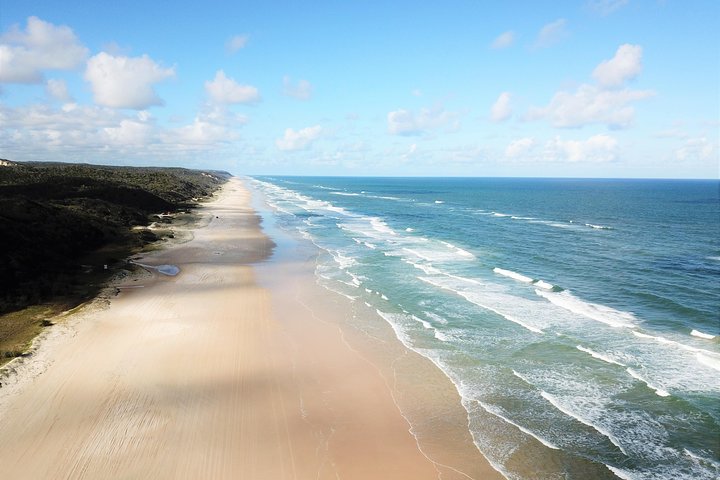
Fraser Island has a long history of shipwrecks, 23 vessels between 1856 and 1935, when the Maheno came ashore. The Sandy Cape lighthouse was built in 1870 in response, but it didn't prevent all wrecks. The Maheno is the most dramatic and most visited of them all.
The wreck is also a reminder of the power of the ocean here. On a calm sunny day it's hard to reconcile this serene beach with the storm that put a 350-foot liner onto it in minutes. During bad weather, and Fraser Island weather can change fast, the power of the ocean here becomes immediately apparent.
Other things to see near the Maheno
75 Mile Beach has more than one reason to stop. The Maheno sits within a short drive of several other Fraser Island main points:
- The Pinnacles (Coloured Sands), 30 minutes north of the Maheno. Ancient sand cliffs showing bands of orange, gold, and red iron oxide. One of the most photographed spots on the island.
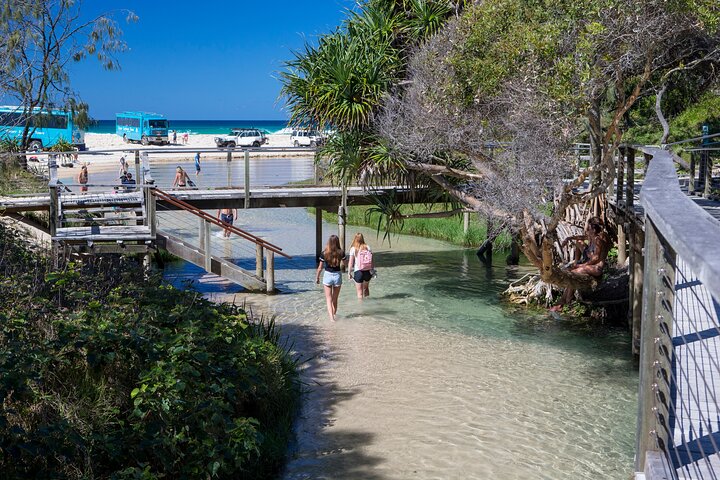
- Eli Creek, 20 minutes south of the Maheno. The largest creek on Fraser Island, pumping 3.5 million litres of fresh water into the ocean every hour. Good for a swim in the creek; the mouth is a popular float spot.
- Indian Head, At the northern tip of 75 Mile Beach. A rocky headland with panoramic views of the island and ocean. The walk up is steep but short; the view is worth it.
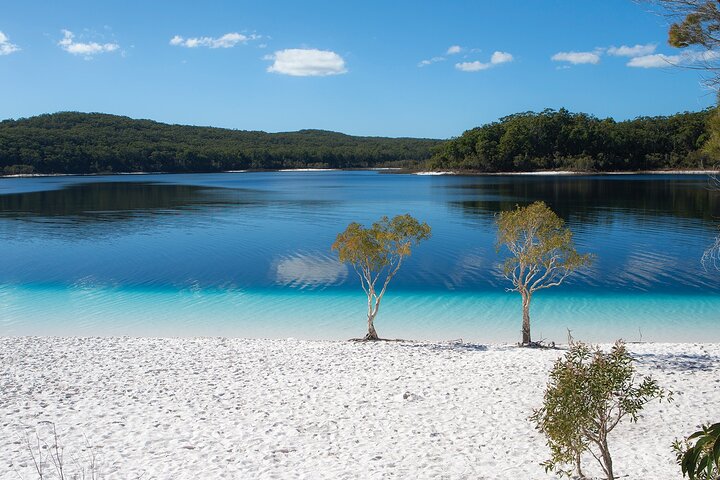
See these and more on a multi-day 4WD tag-along tour, the standard 3-day itinerary covers all of the above plus Lake McKenzie, Central Station, and the Champagne Pools.
See the Maheno on a Fraser Island tour
4WD Tag-Along Tours
The Maheno shipwreck is included on all 2-day and 3-day tag-along tours. You'll also see Lake McKenzie, Eli Creek, the coloured sands, and more, the full Fraser Island experience.
Fraser Island Day Tours
Most day tours from Hervey Bay and Rainbow Beach include the Maheno stop along 75 Mile Beach. A shorter option if you want to see the wreck without the multi-day commitment.
Official info: QLD Parks Fraser Island, official conditions page · Always check QLD Parks Fraser Island for current access conditions before booking.
Is the Maheno Shipwreck right for you?
✓ the Maheno Shipwreck is a good fit if…
- You appreciate maritime history and iconic Queensland landmarks
- You're a photographer – the rusting hull against sand and sky is striking
- You're doing any Fraser Island tour – the Maheno is on virtually every itinerary
- You want a quick, high-impact stop that doesn't require special equipment
✗ Look elsewhere if…
- You expect a museum or interpretive centre – it's just the wreck on the beach
- You're only interested in swimming or active pursuits
- You're visiting at high tide when the wreck is partially submerged
- You have limited mobility – the sand approach is soft and uneven